


20-Second Summary
What is a qualification in business ? And who needs to get these degrees, and how much will they be beneficial in the future? This is a common question for everyone who wishes to know about this qualification and wants to pursue a corporate-level job or start their own business.
As per the World Economic Forum, 54% of all employees will need significant reskilling or upskilling by 2025, making business qualifications more valuable than ever.
This blog post will guide you in detail about:
- Type of Qualifications
- Their Foreign Equivalence and Recognition
- Qualification Criteria
- Their application in business management
- And their benefits
What is Business Qualification?
A business qualification includes your knowledge, skills, and credentials that you use to manage and contribute to a business.

It includes:
- Academic degrees
- Professional certifications
- Industry-specific licenses
- And Foreign credentials
These qualifications help students to
- Shape their careers
- Ensure legal compliance
Our blog post will talk about different types of business qualifications, their requirements, their real-world applications, along with the advantages that they can bring to both professional employees and entrepreneurs.
Who Can Opt for a Business Qualification?
Business qualifications do not require a specific background for those who wish to opt for it soon after college. Once graduated, there are so many options, like master’s, PhD, certifications, licenses, and short courses etc.

- High School Graduates: Any student who has passed grade twelve can opt for business qualifications with a bachelor’s degree to become a Business Administration Student.
- Bachelor’s Holders: Any current employees in the business field, in the corporate sector, can opt for a master’s degree to increase their knowledge and pay scale, for example, to become a Marketing Manager, one can go for a master’s in marketing.
- Master’s Holders: Those who have done a master’s in business qualifications can opt for a PhD if they wish to become a professional business teacher, like a University Business Professor.
- Professionals/Entrepreneurs: Individuals who wish to become entrepreneurs as Startup Founders can also study business qualifications.
Types Of Business Qualifications
There are five basic types of business qualifications that have been briefly explained below:
Academic degrees
- Academic degrees comprise formal business education with academic degrees like BBA, MBA, or MSc in Business.
- Many countries recognize these degrees, but acceptance depends on the school’s accreditation and local rules..
- These degrees provide both theoretical and practical knowledge.
- These degrees add worth to one’s career, for example, U.S. Bureau of Labor Statistics data shows MBA holders earn a median $115,000 annually, nearly double the earnings of bachelor’s degree holders.
Professional certifications
- Some professional certifications can be obtained through the training and assessments. They provide you with business expertise competencies, enhancing your career prospects and helping you to improve your performance by increasing your earnings.

- These certifications can be like CPA, ACCA, and PMP skills in specific areas.
- According to Global Knowledge’s 2023 survey, certified professionals earn 7% to 16% more than their non-certified peers.
Foreign qualifications
One can get a foreign qualification, like an international MBA, that can not only provide global recognition but also improve competitiveness and provide you with diverse cultural business adaptability.

Licensure
Licenses are another type of business qualification that ensures legal compliance. You can use these for lawful practice in regulated industries.
Short Courses
- If you do not want to opt for a long-term degree or give years of commitment, then you can go for short courses, both as physical and online classes.
- These can help you learn targeted skills in business areas like marketing, finance, and project management.
Business Qualification Criteria/Requirements
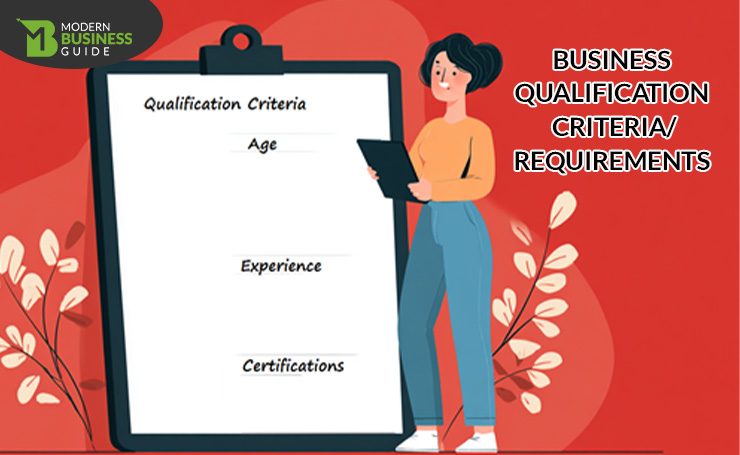
Based on different types of qualifications in business, there are different criteria in different countries that one needs to meet, including certain education, certification, and experience, such as an internship.
Education
- Just as we go from preschool to college, business qualifications also require a minimum academic level.
- For example, a high school diploma is a must for a Bachelor’s in business, a Bachelor’s in business is required for a master’s, and an MPhil for pursuing PhD in business studies.
- Not just that, some specialized programs will also require you to have specific subject backgrounds.
Experience
In order to ensure that you are able to apply your theory in real-life practice and meet the business demands in reality, some degrees also require you to have relevant work experience.

Certifications
In order to enroll in some programs, you may also be required to have professional certifications like ACCA before enrolling for them. These certifications provide them with the assurance that they have the required foundational skills to start the program.
Foreign Qualification for Business
Any business qualification that you get outside your home country, whether it is a degree, certification, or a license, you can use it to boost your career by getting global recognition with a widened professional network.
Recognition
When you get accreditation of your foreign qualifications from reputable institutions, this increases your approval chances with local professional authorities.
Equivalency
Equivalency is also known as the process of matching a foreign qualification to local education. These processes are handled by credential evaluation services like WES.
Processes
- In order to process your foreign degree to get it approved, you need to submit transcripts, their translation if it is in another language, and proof of accreditation to the relevant authorities.
- The approval times for these degrees can range from a few weeks to months.
What Is a Qualification in Business Management
A person qualified in business management has credentials that prove their skills in leadership, team management, strategic decision-making, and driving business growth.

- This qualification is acquired through degrees, certifications, and executive programs that are focused on management.
- With these skills, one can enhance and emphasize the skills like:
- Leadership skills
- Operational planning
- Organizational strategy
The degrees that one can acquire for qualification in business management include a bachelor’s with specialization in management, an MS in business management sciences, an MBA, Chartered Management Institute (CMI) diplomas, and Institute of Leadership & Management (ILM) certifications.
Professional Qualification vs Certification
When it comes to the question What is a qualification in business? There are so many types that we have explored, and answered almost everything around the qualifications and their specific information.

There still is this one question that we need to answer,and it is asked a lot. This is the difference between a professional qualification and certification. Let’s answer this.
Professional Qualification
- A professional qualification is a formal degree awarded by a recognized institute like a business university, taught by business professionals, and providing advanced expertise in a specific profession.
- The professional qualifications often require formal education, work experience, and passing rigorous exams.
- Examples: Chartered Accountant (CA), Chartered Management Accountant (CIMA), and Chartered Financial Analyst (CFA)
Certification
- A certification is a credential awarded after completing a short-term course or passing an assessment to validate specific skills.
- Examples: Project Management Professional (PMP), Google Analytics Certification, and Six Sigma Green Belt.
Now that we have defined them with examples, let us have a side-by-side comparison of both for the metrics that show how one is different from the other.
| Criteria | Professional Qualification | Certification |
| Examples | ACCA, CFA, CIMA, Chartered Accountant | PMP, Google Analytics, Six Sigma |
| Benefits to Career | Long-term career growth, higher earning potential, and leadership roles | Quick upskilling, specialized career advancement |
| Knowledge Depth | Comprehensive coverage of a profession’s theory and practice | Focused on specific skills or tools |
| Duration | 1–5 years, often with work experience requirements | Weeks to months |
| Global Recognition | Widely recognized in the relevant profession across multiple countries | Recognition varies depending on the issuing body |
Benefits of Business Qualification
If you want to pursue a career in the corporate sector or you wish to become an entrepreneur or a business-qualified teacher, then a business qualification can provide you with so many advantages.

- This is an in-demand qualification where many industries are seeking employees with such credentials and experience, making those with business qualifications highly employable.
- One can increase their skills by taking extra certifications and short courses during their employment to get an increase in their pay scale and also to avail promotion.
- Business qualifications also provide one with skills like leadership, team management, communication, problem-solving, critical thinking, and project management that are highly effective to learn as an individual, not just for your company and team, but for you as well, in case you wish to start your own business later on.
- Business qualifications are also known to provide a faster experience with above-average growth and long-term earning potential.
- By availing these qualifications, you also get to meet and network with highly qualified business peers during your education, like professors, and industry professionals through practical work like internships.

- Other than providing a good pay scale and practical skills, these qualifications also help you with your individual skills:
- You develop personal financial, marketing, and management skills.
- You increase your credibility in the industry.
- A business qualification also develops entrepreneurial skills within individuals, helping them to start their own business startups and not just make an income but also add to the GDP of the country.
- You do not get stuck with your degree; a business-qualified person can enhance their skills and business knowledge based on industry changes happening across the globe by taking new courses, seminars, and workshops on recent industry developments and changes, and stay up-to-date both on their resume and for their individual growth.
Final Remarks
A business qualification is a foundation for those who wish to pursue their careers in the corporate sector, business teaching, or start their own business.
According to the OECD, individuals with tertiary education, such as business degrees, earn on average 57% more than those with only secondary education across member countries. In the U.S. alone, Workers in business and financial roles earn a median annual wage of $80,920, significantly above the overall average of $49,500, highlighting how strong business qualifications can elevate your income and career.
This blog post has given a comprehensive guide on business qualification, its types, and its financial, skill-building, and personal development benefits.
If you wish to learn more about business insights, practical and updated business knowledge, keep visiting Modern Business Guide.
Frequently Asked Questions
What is the main purpose of a business qualification?
A business qualification provides you with specialized skills that you need to operate and manage the business officially.
Which business qualification is most valuable in 2025?
An MBA is still the most valuable qualification in 2025. You can enhance its value and credibility with extra business-related courses and certifications.
How long does it take to complete a business qualification?
It depends on the type of qualification; a short course can be completed in a few weeks, whereas a degree like a PhD can take five years to complete.
Can a business qualification increase my salary?
Yes. When it comes to global recognition, OECD data shows tertiary education holders earn 57% more on average. If we talk about just the USA, then as per BLS reports MBA holders often earn nearly double bachelor’s graduates.
How do I choose the right business qualification for my career?
You must look at your current job role requirements, industry requirements, your budget, and time commitment before selecting any business qualification.
