


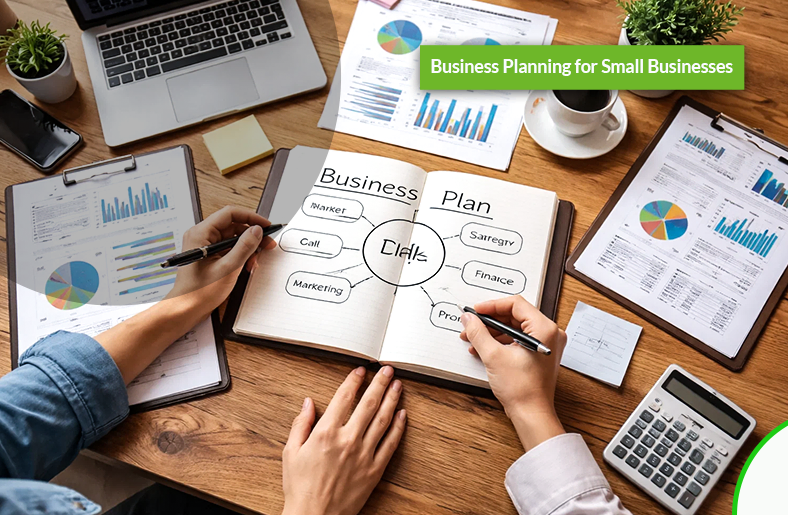
Did you know that around 20% of small businesses fail within the first year and 45% within the first 5 years? If you are also starting a small business, don’t let these numbers scare you. By sticking to a business plan, you can increase your chances of survival in the market.
This is why this guide discusses business planning for small businesses. It is clear and approachable, and by the end of it, you will be able to create a winning plan.
30-Second Summary
- A business plan is a useful tool to turn ideas into structured, actionable strategies.
- Accurate financial projections and realistic start-up costs reduce risk.
- Strong market research and competitive analysis help you stand out.
- Your business plan should be flexible and adjust to market changes.
What Is a Small Business Plan?
Before jumping into the steps of business planning, first, let’s establish what a business plan is. It is basically a roadmap that outlines your company’s goals and the methods to achieve them.

You might be thinking, “Why do you need a business plan when you have a solid idea?” The fact is that ideas alone are fragile. A business plan is necessary to turn them into actionable strategies. It allows you to clearly think about your money, customers, risks, and growth, and also makes you reliable for investors.
This is how you can make a strong business plan.
Step 1: Write a Clear Executive Summary
An executive summary is a quick snapshot of your business. It should comprehensively convey everything about your business to persuade the reader to learn more. This is what an executive summary should include.

- Concept of your business (what it does and offers)
- Company information (its name, team, size, location, etc.)
- Growth highlights that show how much your company has progressed after its inception
- Your products and services, describing what you sell and how it benefits the customers
- Financial information, including an overview of projections and what you need from investors
- Future plans, representing where you want to take your business in the future
Step 2: Define Your Business Overview and Legal Structure
Describe your business in detail, including its vision and mission statement and legal structure. A vision statement shows your future aspirations, and a mission statement is all about your current operations and the methods you use to achieve those aspirations.
Moreover, determining and defining your business’s legal structure is important because it impacts taxes, funding, and liability. Here is the complete blog on different business types and their responsibilities.
Step 3: Determine Services or Products
Describe what your business offers. Is it a service or a product? If you sell a service, explain it in detail and also list all associated costs. If you sell a product, describe how it is produced, its cost, and how you want to sell it.
Step 4: Conduct Thorough Market Research
In this section, you define the industry you are active in and do thorough research about it. Include information about your target customers and analyze your own pros and cons through SWOT analysis.

- See how broad your industry is, its growth rate, trends, and future.
- Understand your customers’ demographics, including age, gender, geographic location, and income level. Also account for psychographic factors like values, lifestyle, and attitudes.
- Figure out where your product or service fits in the market. Your offerings should either fill a gap, meet an unfulfilled need, or improve existing services.
- Understand laws and regulations that impact your industry, such as licenses, permits, and other regulatory compliance requirements.
- Assess your business’s key strengths, weaknesses, opportunities, and risks through SWOT analysis. It will give you a clear idea of your brand’s position in the market and what you need to do to grow it further.
Step 5: Perform Competitive Analysis
Competitive analysis shows you what your competitors are doing and how they are managing their brands. You need to recognize your direct and indirect competitors.
- Direct Competitors: Direct competitors sell similar products to the same customers to capture market share directly. A common example of this type of competition is Pepsi and Coca-Cola.
- Indirect Competitors: Indirect competitors offer different services or products that satisfy the same customer need or goal, for instance, movie theaters and Netflix.
Here, you need to create a strategy that differentiates your brand, and for that, you need a unique selling proposition (USP). It could be lower prices, faster services, or something else that makes you stand out.
Step 6: Develop Your Marketing Strategy
This section is crucial because it determines how you plan to attract and retain your customers. Describe your sales plan and what marketing channels you will use to get as many customers as you can.

- You have already described your target audience and its demographics. Now, you need to choose the marketing message they will respond to.
- Explain the prices of your services or products and why they will appeal to your target audience. Detail your forecast for your potential market share and sales.
- Decide how you will show the uniqueness of your product or service in your marketing strategy.
- Explain your sales plan that determines how you will sell your products or services. Determine whether you want a physical shop, an online business, or both. Will you hire a sales team, and how do you want to bring your business into the market?
- Create a promotional strategy that highlights which medium you will use. It can be social media marketing, advertising, SEO, content marketing, or PR, etc.
- Outline your retention strategy and explain how you will encourage your customers to place repeat orders. It could involve top-notch customer service, loyalty programs, and product/service improvements, etc.
- Discuss any partnerships and collaborations that will play an integral role in your marketing and sales strategy.
- Lastly, define how you will measure the success of your sales and marketing campaigns. You can monitor KPIs (key performance indicators), such as customer acquisition cost, customer lifetime value, conversion rate, and website traffic.
Step 7: Outline Operations and Startup Costs
In this section, outline your operations and startup costs in two categories: one-time pre-launch expenses and recurring post-launch costs. Moreover, add 20% contingency fund in case of any unexpected costs.
Startup Costs (One-time)
It includes
- Legal and administrative costs, such as business registration, permits, licenses, and counsel fees
- Physical setup, including security deposits, renovations, office or store build-out
- Assets, including computers, furniture, machinery, and initial inventory
- Initial branding and marketing, such as website development, logo design, and marketing campaigns
Operational Expenses (Recurring)
It includes
- Your team’s expenses, like salaries, payroll taxes, and benefits
- Fixed costs, including rent, insurance, and utilities (internet, electricity, etc.)
- Variable costs, such as marketing, maintenance, software subscriptions, and inventory restocking
Step 8: Create Financial Projections
Explain a forecast of your business’s financial future. It can include cash flow statements, balance sheets, and income statements for the next 3 to 5 years.

Include the following.
- Sales forecast: This is the amount of money you expect to make through selling your products and services. It should be broken down monthly for the first year and annually for the next two to five years.
- Balance sheet: This is a snapshot of your company’s financial situation at a particular moment in time. It highlights your assets, liabilities, and equity.
- Income statement: This profit and loss statement shows your company’s profitability over time. It includes costs of goods sold, operating expenses, net income, and revenue.
- Cash flow statement: This shows where your business earns and spends money and highlights how income and balance sheet items affect your cash or cash equivalents.
- Capital expenditure budget: If you have large expenses for long-term assets, like property or equipment, detail them.
- Break-even analysis: It shows when your business can make profits and cover all the expenses.
- Financial ratios: These ratios compare financial metrics from your company’s financial statements to evaluate its financial health. They can show how well your business is performing.
Step 9: Secure Business Funding
If you are looking for investors or want business loans, you should include a funding request in your plan.
- Start with a funding request that clearly describes the amount you are seeking.
- Explain how you plan to use these funds. You can get funding for starting, working capital, expanding the business, or any other company-related expenses.
- If you expect to get funding in the future as well, mention it clearly. Include a clear estimate of how much you might need, when you will need it, and where you will use it.
- Include a snapshot of your financial statements and forecasts. Add details about the income statement, cash flow statement, business loans, and other relevant information.
- If you want equity investment, explain your exit strategy. This may include merging with another company, selling your business, or going public with an IPO (initial public offering).
- Finally, if you are requesting a loan, clearly state when and how you will repay it. Include a schedule and method of repayment.
Step 10: Appendix of Supporting Documents
This is an optional section that includes any supporting documents, such as contracts, permits, and legal documents.
Traditional Plan vs Lean Startup Plan
| Feature | Traditional Business Plan | Lean Startup Plan |
| Length | 20 to 40+ pages | 1 to 3 pages |
| Level of Detail | Highly detailed and structured | Concise and focused |
| Purpose | Used to secure loans, investors, or grants | Used for internal planning and quick validation |
| Best For | Businesses seeking external business funding | Startups testing ideas quickly |
| Structure | Fixed sections (executive summary, market research, financial projections, etc.) | Flexible format (key metrics, value proposition, cost structure) |
| Time to Create | Weeks to months | A few hours to a few days |
| Financial Focus | Includes detailed revenue projections, profit and loss statement, and cash flow statement | Basic financial assumptions and cost estimates |
| Market Research | In-depth industry and competitive analysis | Lean research focused on problem-solution fit |
| Flexibility | Less adaptable once completed | Easily updated as the business evolves |
| Common Users | Established small businesses or serious growth-stage startups | Early-stage startups or solo entrepreneurs |
| Template Sources | Often follows SBA (Small Business Administration) guidelines | Often inspired by lean canvas models |
Why do Business Plans Fail?
A business plan is not exactly a complete guarantee of success. You may include unrealistic assumptions or projections, or the market and economy may change in an unexpected way. Moreover, your competitor can introduce a revolutionary offering that makes them stand out.
To be on the safe side, keep your plan flexible so that, whenever something unforeseen happens, it is easy to change course.
How Often Should a Business Plan be Updated?
This depends on the nature of the business plan. Updating the plan is necessary due to changing external factors (market, trends, competition, etc.) and internal factors (growing teams, new offerings, etc.).

A well-established business might need to revise the plan every year to make necessary changes. A new company in a cutthroat market should update it more frequently, like quarterly.
Common Business Planning Mistakes to Avoid
Here are some mistakes you should avoid for a successful business plan.
- Unrealistic financial projections
- Ignoring market research
- Overestimating revenue projections
- Underestimating the startup cost
- Weak competitive analysis
Free Resources and Templates
In 2026, business planning is no longer a confusing process. You do not need to stare at a blank page anymore. Now you have multiple free resources that help you brainstorm, organize your ideas, and even write for you.
Here are some of these resources.
- Free templates: These have a pre-designed outline that shows you exactly what you need to write in a certain section. They also make sure nothing important gets left out.
- Business plan generator: These are interactive tools that ask you questions and create a ready-to-use plan based on your answers. These are great for beginners, as they prevent the stress of writing everything from scratch.
- AI business plan writer: These are advanced platforms that draft the plan as well as suggest improvements.
- Spreadsheet tools: These are ready-made financial models that make it easy to calculate break-even points, track startup costs, and project numbers with accuracy.
Wrapping Up
Business planning for small businesses and startups does not have to be overwhelming. With the right approach, anyone can easily turn an abstract idea into an organized, actionable strategy. The best part is that this process is now more accessible than ever with modern tools and free templates.
For more business-related information, feel free to explore Modern Business Guide.
FAQs
How do I write a Business Plan for a Small Business with no Experience?
Start with a simple business plan template and focus on clearly explaining everything rather than perfection. Research your market, estimate realistic startup costs, and create basic financial projections. Many beginners also use SBA (Small Business Administration) guides and mentorship from reliable resources to avoid common mistakes.
What Financial Projections are Required in a Small Business Plan?
Most lenders anticipate a sales forecast, cash flow statement, profit and loss statement, and a 3- to 5-year revenue projection. These documents show whether your business can stay profitable and manage cash effectively.
Is a Lean Startup Plan better than a Traditional Business Plan?
A lean startup plan is better for testing your ideas quickly and adjusting the strategy accordingly. However, a traditional plan might be more suitable when you are applying for loans or presenting to the investors.
